Every May, tens of thousands of students complete the AP Calculus BC exam with a strong grasp of limits, derivatives, integrals, and series, yet remain uncertain about how that performance will translate into a final score. This uncertainty does not stem from a lack of mathematical transparency in the classroom. It arises from the scoring system itself, which operates through a layered conversion process that is not fully visible to test takers.
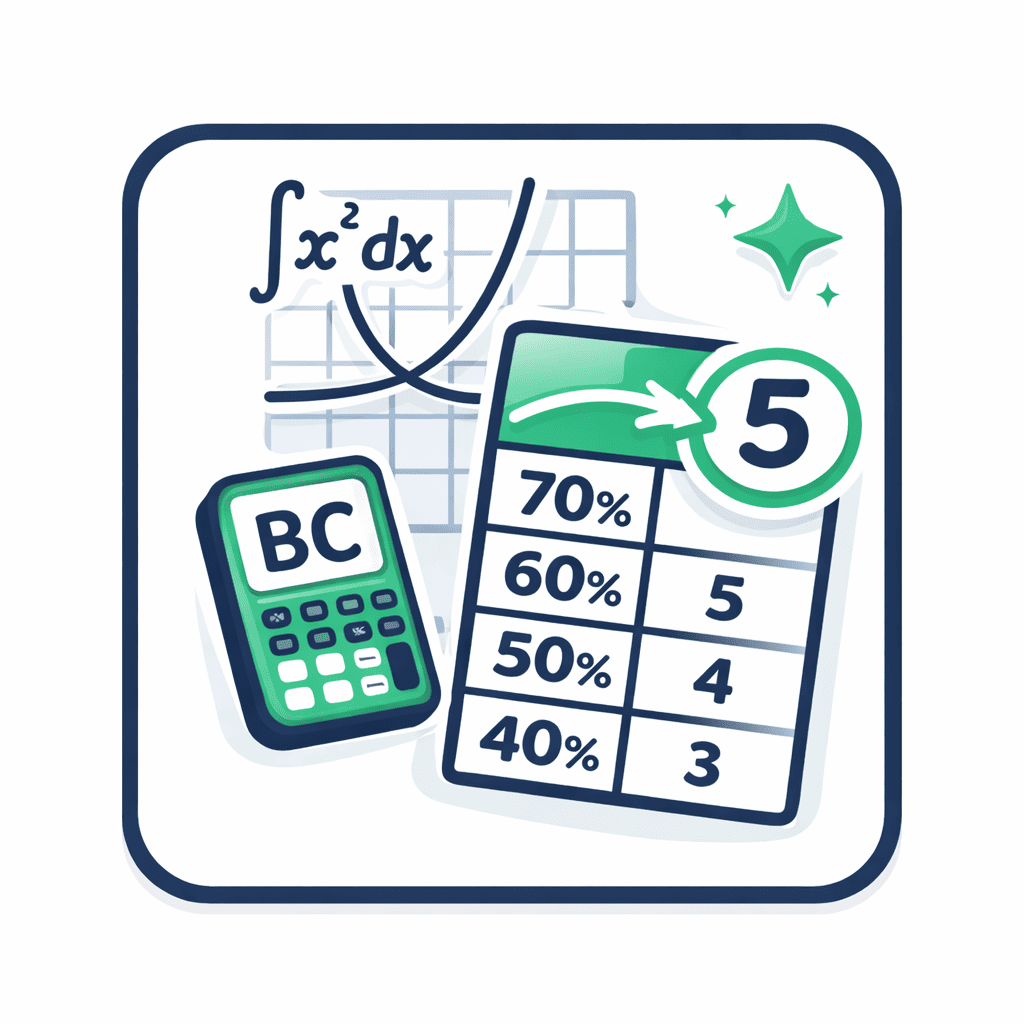
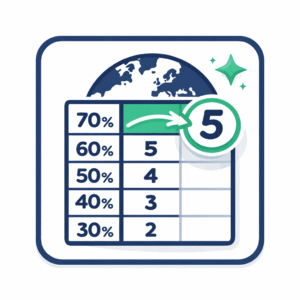
At the center of that process sits the AP Calc BC score conversion chart. It is not an official document, nor is it published by the exam’s governing body. It is a reconstructed framework, built from historical data, section weights, and released score distributions. Its purpose is practical: to approximate how raw exam performance converts into the familiar 1–5 AP scale.
Understanding this chart requires examining how AP Calculus BC is scored, why conversion ranges shift slightly each year, and how students and educators responsibly use tools such as an ap calc bc score calculator or an ap calculus bc score estimate.
Institutional Authority and Scoring Intent
AP Calculus BC is administered by the College Board, which oversees all Advanced Placement exams. The College Board frames AP scores as indicators of college-level achievement rather than competitive rankings.
Its official definition states:
“AP Exam scores are reported on a 5-point scale that is designed to be equivalent to the grades students earn in college courses.”
(College Board – About AP Scores)
This definition explains why the score conversion chart exists in the first place. The chart does not rank students against one another. It aligns exam performance with external academic standards set by college faculty who participate in the AP program.
Why No Official Conversion Chart Exists
The College Board does not publish official AP Calculus BC score conversion charts. This absence is deliberate. Fixed cutoffs would undermine the statistical adjustments required to maintain score consistency across different exam forms.
The College Board addresses this variability directly:
“The exact score needed to earn a particular AP grade varies from exam to exam.”
(College Board – AP Scores)
As a result, any AP Calc BC score conversion chart available to students is an estimate derived from historical patterns rather than an official rulebook.
Structure of the AP Calculus BC Exam
Conversion charts rely on exam structure. AP Calculus BC consists of two equally weighted sections.
Section I: Multiple Choice
45 questions
1 hour and 45 minutes
50 percent of the total score
The section includes 30 non-calculator questions and 15 calculator-permitted questions. Each correct answer earns one raw point. Incorrect answers do not reduce the score.
Section II: Free Response
6 questions
1 hour and 30 minutes
50 percent of the total score
The free-response section includes two calculator-active questions and four non-calculator questions. Each free-response question is typically scored on a 0–9 scale using analytic rubrics.
Raw Scores and Composite Scores
The raw score represents the first measurable outcome of the exam.
Multiple choice: 45 points maximum
Free response: 54 points maximum
The combined raw maximum equals 99 points. Raw points are never reported to students. They serve as inputs for a weighted composite score.
The two values combine into a composite score on a 0–100 scale. Most ap calc bc score calculator tools use this structure.
The Role of the AP Calc BC Score Conversion Chart
Once a composite score is calculated, it must be mapped to a final AP score from 1 to 5. This mapping is where the conversion chart comes into play.
Educators and analysts reconstruct approximate ranges using historical data from released score distributions. Long-term patterns show notable stability.
5: composite score in the high 60s and above
4: composite score in the mid-50s to high 60s
3: composite score in the low 40s to mid-50s
2: composite score in the mid-20s to low 40s
1: composite score below the mid-20s
These ranges represent probability bands rather than guarantees.
Score Needed for a 5: What the Data Show
The score needed for a top result often surprises students. Perfect performance is not required.
For the 2023 AP Calculus BC exam, the College Board reported:
This unusually high percentage reflects the advanced preparation and self-selection typical of BC test takers. In many years, composite scores in the upper 60s have aligned with a 5.
Statistical Equating and Score Stability
Conversion charts sit atop a statistical process known as equating. Equating adjusts score thresholds to maintain consistent meaning across exam administrations.
The College Board explains the goal:
“Equating ensures that a score of 3 on one AP Exam represents the same level of achievement as a score of 3 on another AP Exam.”
(College Board – Score Equating)
The National Council on Measurement in Education offers a broader explanation:
“Score scales are statistical constructs derived from equating procedures that are not directly observable by test takers.”
(NCME Publications)
Why Students Use Score Calculators
Despite their limits, score calculators remain widely used.
A 2022 survey by the National Association for College Admission Counseling found that more than half of AP students sought unofficial score estimates before official results were released.
(NACAC Research)
Students use tools such as an ap calculus bc score estimate to translate practice exam results into scaled outcomes, track progress, and reduce uncertainty during the waiting period.
Limits of the Conversion Chart
Conversion charts cannot account for human scoring variation in free-response questions, differences in partial-credit methods, or annual equating adjustments.
Each free-response question carries up to nine raw points. One question can equal the value of nine multiple-choice items.
This weighting explains why conversion charts heavily reflect free-response performance. Modest improvements in explanation, structure, or justification often produce larger composite score gains than large increases in multiple-choice accuracy.
Calculator Use and Scoring Expectations
Calculator-active questions permit graphing calculators. Scoring does not reward computation alone.
The College Board clarifies:
“Students are expected to demonstrate mathematical reasoning and not just perform calculations.”
(College Board – AP Calculus BC)
Using Conversion Charts for Preparation
The most productive use of a conversion chart occurs before exam day.
When students input practice results into an ap calc bc score calculator, patterns often emerge related to free-response weaknesses, justification errors, and section balance.
Common Misinterpretations
Several misunderstandings recur, including treating estimated cutoffs as fixed rules, assuming exact year-to-year stability, and overestimating free-response scores.
Alignment With College Credit Policies
Colleges use AP scores to grant placement or credit. Many institutions award credit for scores of 4 or 5 in Calculus BC, while others use scores for placement decisions.
The conversion chart supports this system by anchoring scores to external performance standards rather than percentile ranks.
Final Considerations
The AP Calc BC score conversion chart represents an informed reconstruction of a closed scoring process. It reflects exam structure, section weights, historical distributions, and statistical equating.
Its value lies in interpretation rather than prediction. Students who understand how composite scores map to scaled results approach preparation and score analysis with greater clarity, fewer misconceptions, and stronger alignment with how AP Calculus BC is evaluated.