Advanced Placement Calculus occupies a distinct position within secondary mathematics education. The exams labeled AP Calculus AB and AP Calculus BC evaluate mastery of limits, derivatives, integrals, and related applications through a standardized scoring system that converts raw performance into a scaled score from 1 to 5. This system often appears opaque to students and families, especially when attempting to estimate outcomes through tools such as an ap calc score calculator or an ap calculus score calculator. A closer look at the mathematics behind the scoring process clarifies both its logic and its limits.
The structure of the exams
Both exams follow a carefully engineered format designed to balance procedural fluency with conceptual reasoning. According to the College Board, AP Calculus AB and BC share the same structure, differing only in content scope and difficulty.
Each exam contains two main sections:
Multiple-choice section
Forty-five questions completed in 105 minutes. This section accounts for 50 percent of the total raw score.
Free-response section
Six questions completed in 90 minutes. This section accounts for the remaining 50 percent.
Within the multiple-choice portion, some questions permit calculator use while others do not. The free-response section follows a similar split. The intent is not technological proficiency but mathematical reasoning. The College Board states that calculators are included “to reduce the computational burden while allowing students to demonstrate conceptual understanding,” language that appears verbatim in its public exam description ( College Board AP Calculus Course and Exam Description).
Raw scoring mechanics
Scoring begins with raw points. For multiple-choice questions, each correct answer earns one point. There is no penalty for incorrect responses or omissions, a policy adopted in 2011 across all AP exams. A student answering 28 of the 45 multiple-choice questions correctly earns 28 raw points for that section.
Free-response scoring follows a rubric-based system. Each question carries a maximum of nine points, distributed across clearly specified steps. Partial credit plays a central role. A student who sets up an integral correctly but evaluates it incorrectly still earns credit for the correct reasoning. Across six questions, the free-response section yields a maximum of 54 raw points.
At this stage, calculators such as an ap calc ab score calculator or ap calc bc score calculator operate only at an approximate level. They can combine correct multiple-choice answers and estimated rubric points, yet they cannot replicate the nuance of official scoring, especially for partially correct reasoning.
Weighting and composite scores
Once raw scores are tabulated, they are weighted. The multiple-choice raw score is scaled to a maximum of 50 composite points. The free-response raw score is scaled to another 50 composite points. The sum produces a composite score out of 100.
This weighting ensures that neither speed nor written reasoning dominates the outcome. A student with strong conceptual explanations but weaker multiple-choice accuracy can still earn a high composite score. This balance reflects decades of psychometric research conducted by the College Board and its academic advisory committees.
The role of scaling
The most misunderstood element arrives next. Composite scores do not translate directly to AP scores. Instead, they are converted through a process known as equating. Equating adjusts for minor variations in exam difficulty from year to year.
The College Board describes this process precisely: “Equating ensures that scores have the same meaning from one administration to another.” This sentence appears verbatim in its technical documentation on AP score setting ( College Board AP Score Setting and Equating). No curve compares students to each other. Performance is measured against fixed standards.
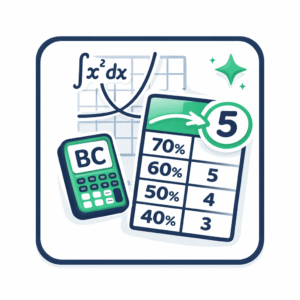
Historical conversion charts illustrate this effect. On recent AP Calculus AB exams, a composite score near 70 has often corresponded to an AP score of 5, while a composite score near 58 has mapped to a 4. For AP Calculus BC, the thresholds trend higher, reflecting the additional topics such as series and parametric equations. These values shift slightly each year after statistical review.
Why BC includes the AB subscore
AP Calculus BC includes an AB subscore, reported on the same 1–5 scale. This subscore isolates performance on topics common to both exams. Its calculation relies on a subset of questions embedded within the BC exam.
Colleges sometimes use this subscore for placement decisions when a student earns a lower overall BC score but demonstrates strong AB-level mastery. The College Board notes that the AB subscore “indicates achievement in the foundational calculus topics,” phrasing used directly in its score reporting guide ( AP Score Reports for Educators).
Free-response grading and reliability
Free-response answers are graded each June by trained educators at centralized scoring sites. Every response passes through multiple layers of review. Readers follow rubrics developed by college faculty and experienced AP teachers. Calibration sessions precede scoring, and consistency checks occur throughout the process.
Statistical moderation plays a quiet yet decisive role. If a reader’s scoring pattern deviates from established norms, responses are rescored. This quality control reduces random variation and preserves comparability across years.
Interpreting score calculators
Online tools such as an ap calculus score calculator offer students an estimate, not a prediction. These tools typically apply published weighting rules and past-year cut scores. Their limitations arise from three factors:
Annual equating adjustments remain confidential until after scoring concludes.
Free-response partial credit cannot be precisely estimated without official rubrics.
Composite-to-score boundaries fluctuate within narrow but meaningful ranges.
Used carefully, a calculator supports planning and reflection. Used carelessly, it fosters false certainty. The distinction matters when setting expectations.
What the numbers mean in practice
AP scores correlate with college outcomes, though not perfectly. A College Board analysis of students enrolled in calculus-based STEM courses found that those earning AP Calculus scores of 4 or 5 earned higher first-year GPAs than peers without AP experience, even when they repeated calculus in college ( College Board Research: AP and College Performance). This correlation supports the exam’s predictive intent, not as a gatekeeper but as an indicator.
Colleges interpret scores differently. Some grant credit for a 3, others require a 4 or 5. Engineering programs often set higher thresholds than liberal arts programs. The score itself remains constant; its use varies by institutional policy.
Misconceptions about curves
One persistent myth holds that only a fixed percentage of students may earn each score. This belief conflicts with published methodology. The College Board states unambiguously that “AP scores are not curved to a preset distribution.” The wording appears exactly in its scoring overview ( How AP Exams Are Scored). In years when performance rises, more students earn higher scores. In years when performance falls, fewer do.
Strategic implications for students
Understanding scoring influences preparation strategy. Accuracy matters, yet clarity of reasoning matters equally. On free-response questions, setting up the correct integral or derivative often earns the majority of available points. Complete numerical evaluation, while valuable, carries less weight than structural correctness.
Time management also interacts with scoring. Leaving a question blank guarantees zero points. Attempting a partial solution often earns credit. This asymmetry favors thoughtful engagement over perfection.
Historical perspective
AP Calculus launched in 1956, making it one of the earliest AP subjects. Over time, scoring standards have remained stable while content evolved. The introduction of Calculus BC in 1969 expanded the curriculum to reflect first-year college sequences more accurately. Despite these changes, the 1–5 scale has persisted, providing longitudinal continuity across generations of students.
Final Considerations
AP Calculus AB and BC scoring rests on a framework shaped by mathematics, statistics, and educational measurement. Raw points, weighted composites, and equating form a layered system designed to preserve fairness across administrations. Tools such as an ap calc score calculator, ap calc ab score calculator, or ap calc bc score calculator assist with estimation, yet they remain approximations.
Clarity emerges when the process is viewed not as a mystery but as a structured translation from demonstrated reasoning to standardized scale. The exam rewards mathematical thinking expressed under constraint, then anchors that performance to stable standards. For students, teachers, and families, that understanding replaces anxiety with informed expectation.