Understanding how the AP Physics 1 exam is scored requires attention to arithmetic structure rather than test-day folklore. The scoring system follows a defined statistical workflow designed to balance raw performance, question difficulty, and year-to-year consistency. This process rarely receives a full explanation in classrooms, yet it directly shapes outcomes for more than 170,000 students annually, according to participation figures published by the College Board.
The exam itself blends two scoring traditions: machine-scored multiple-choice items and human-scored free-response problems. What happens after those scores are recorded involves scaling, moderation, and statistical equating. Each step introduces mathematical constraints that reward precision, partial reasoning, and consistency across administrations.
This article examines that process with a quantitative lens, focusing on what the math behind the scoring actually does and does not do.
Multiple-choice questions receive one point for each correct answer. No deductions apply for incorrect responses. The raw multiple-choice score therefore ranges from 0 to 50.
Free-response questions follow a rubric with itemized point allocations. Each question usually allows between 7 and 12 points, depending on the task. Across the section, the raw free-response total generally ranges from 0 to 45.
The combined raw score thus falls near a maximum of 95 points. That number alone does not determine the reported AP score. It acts as an intermediate variable in a scaling system that transforms raw performance into a standardized 1–5 outcome.
The College Board states on its official scoring overview that “AP scores are reported on a 5-point scale, where 5 is the highest score.” This description appears on its AP score scale page and reflects the final reporting format rather than the underlying calculations.
Weighting mathematics and why raw totals are misleading
Each exam section contributes approximately half of the final composite score. In practice, the College Board applies weights rather than a direct percentage split. Multiple-choice and free-response raw points are first converted into weighted scores, then summed into a composite.
A simplified representation often used in classrooms assigns a 50 percent weight to multiple-choice and a 50 percent weight to free-response. Under that approximation, each multiple-choice question contributes roughly one composite point, while each free-response point carries slightly more weight. This difference compensates for the smaller number of free-response points and their richer evidence of reasoning.
Many unofficial tools attempt to replicate this process. An ap physics 1 score calculator usually estimates the composite score by applying historical cutoffs to weighted raw totals. These tools help students model scenarios, yet they rely on assumptions rather than current-year calibration.
The key mathematical takeaway remains consistent: raw points do not translate linearly into AP scores.
Scaling and statistical equating
After raw scores are tallied, the College Board applies a scaling procedure known as equating. The purpose involves maintaining score meaning across different exam forms. A 4 earned in one year reflects the same level of achievement as a 4 earned in another year, even when questions differ.
Equating uses anchor questions and historical performance distributions. Some items repeat across years or appear in pilot form prior to full release. These anchors allow statisticians to compare cohort performance and adjust score boundaries.
In its technical explanation of AP assessment practices, the College Board explains that equating “adjusts for slight differences in difficulty among exam forms so that scores have the same meaning from year to year,” a description found in its official scoring FAQs.
From a mathematical standpoint, equating functions like normalization. Raw score distributions shift slightly, and cut scores move accordingly. Fixed percentages or rigid point thresholds do not apply.
Why score cutoffs change every year
Public discussions often ask why a score of 70 might earn a 4 one year and a 3 another. The answer lies in cohort performance and exam difficulty.
AP Physics 1 historically produces lower average scores than many other AP subjects. Publicly released score distributions show that fewer than half of test-takers earn a 3 or higher in most years. That pattern reflects the conceptual demands of the course rather than grading severity.
When exam questions trend more challenging, cut scores may shift downward. When student performance improves across the cohort, cut scores may rise. The scaling algorithm balances both effects.
This reality limits the accuracy of any ap physics 1 exam score calculator that relies on a single year’s data. Calculators can model possibilities, yet they cannot access current anchor item statistics or national performance curves.
Free-response scoring and partial credit mathematics
Free-response questions introduce another mathematical layer: rubric-based scoring. Each scoring guideline divides reasoning into discrete elements. Points attach to physical principles, correct equations, units, diagrams, and logical consistency.
Readers trained during the annual AP Reading score thousands of responses. Inter-rater reliability receives constant monitoring. When discrepancies appear, table leaders recalibrate scoring through discussion and sample re-reads.
From a numerical perspective, free-response scoring behaves like a vector sum of micro-decisions. A student may earn points for a correct setup even with an incorrect final answer. This structure explains why conceptual clarity often outweighs arithmetic completion.
Physicist and educator Eric Mazur addressed this issue in a Harvard interview, stating, “The traditional focus on getting the right answer often masks whether students actually understand the underlying concepts,” as reported by the Harvard John A. Paulson School of Engineering and Applied Sciences.
Composite scores and the 1–5 scale
Once weighted section scores combine into a composite, that number maps to the final AP score. The mapping uses cut scores determined after equating.
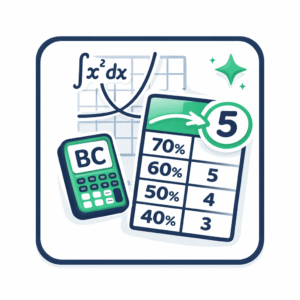
While exact composite thresholds remain unpublished, historical ranges circulate widely. In many administrations, composite scores in the high 60s or low 70s correspond to a 5, while a 3 may begin near the mid-40s. These figures vary year to year.
The College Board’s annual score distributions confirm that the 1–5 scale represents performance bands rather than percentiles. A score of 3, described by the College Board as “qualified,” indicates readiness for introductory college coursework.
Interpreting score calculators responsibly
Students frequently search for tools to calculate ap physics 1 score projections after practice exams. These tools provide scenario planning rather than guarantees.
A responsible calculator incorporates separate treatment of multiple-choice and free-response sections, weighting consistent with recent exams, and multiple possible cut score ranges.
When used carefully, an ap physics 1 score calculator helps identify performance margins. It cannot replace official scoring, yet it can guide study priorities. For example, a student near a cutoff may see that improving free-response reasoning yields greater composite gains than marginal multiple-choice improvements.
The mathematical logic mirrors risk analysis. Small improvements in higher-weight components often deliver larger expected value.
Common scoring myths and numerical reality
Several misconceptions persist around AP Physics 1 scoring. Guessing does not reduce scores, free-response answers do not require perfect arithmetic, and raw percentages do not determine final results. Each myth dissolves under numerical inspection.
The scoring system rewards breadth of understanding and method consistency rather than isolated correctness.
Historical context and stability of the model
The AP program introduced physics exams in the 1950s. Over decades, scoring methods evolved alongside psychometrics. The modern AP Physics 1 exam, launched in 2014, emphasized conceptual reasoning and algebra-based modeling.
Score distributions since that redesign show relative stability. While yearly fluctuations occur, the overall pattern remains consistent. That stability suggests the equating system functions as intended.
As noted in College Board redesign documentation, the goal involved aligning high school physics assessment with college-level expectations for scientific reasoning. That alignment rests on scoring mathematics as much as curriculum content.
Strategic implications for students
Understanding scoring mechanics supports strategic preparation. Emphasizing reasoning steps in free-response practice, avoiding leaving multiple-choice items blank, and using calculators for range estimation all follow directly from the mathematics of scoring.
From a quantitative viewpoint, preparation resembles portfolio optimization. Time invested in conceptual clarity produces higher marginal returns than memorization or speed alone.
Final Considerations
The AP Physics 1 scoring system reflects applied mathematics in service of fairness and consistency. Raw points feed into weighted composites. Those composites undergo equating. Final scores represent performance bands rather than fixed percentages.
Students who grasp this structure approach the exam with clearer expectations and calmer analysis. Score calculators, when used wisely, support planning rather than speculation. Above all, the scoring math reinforces a broader lesson from physics itself: structure matters, assumptions matter, and understanding the system changes how outcomes appear.