The question of what constitutes a good AP Calculus score appears simple on the surface. The Advanced Placement scale runs from 1 to 5, with higher numbers indicating stronger performance. Yet that numerical clarity fades once the score enters real-world contexts such as college credit, placement decisions, scholarships, and personal academic goals. A score that proves valuable in one setting may hold limited weight in another. Understanding what “good” means requires attention to data, institutional policy, and the mechanics of AP scoring itself.
This article examines AP Calculus scores through several lenses: national distributions, college credit standards, longitudinal outcomes, and the practical use of score estimation tools. The intent is not to rank students but to clarify how scores function and how they are interpreted.
How AP Calculus scores are defined
AP Calculus exams, both AB and BC, are scored on a five-point scale. The College Board defines the scale in performance terms rather than percentages. A score of 5 indicates “extremely well qualified,” while a 3 indicates “qualified.”
This phrasing frames scores as standards-based rather than comparative. Students are not ranked against one another. Each score reflects performance against fixed expectations set by college faculty.
National score distributions as context
One way to assess whether a score qualifies as good involves national distributions. These distributions reveal how frequently each score occurs, offering context rather than judgment.
In the 2023 administration of AP Calculus AB, the College Board reported the following approximate outcomes:
About 21 percent of students earned a 5
Roughly 18 percent earned a 4
Around 23 percent earned a 3
For AP Calculus BC in the same year, results skewed higher:
Within this framework, a score of 3 already places a student above a substantial portion of test takers, particularly in Calculus AB.
College credit as a practical benchmark
For many students, the definition of a good score aligns closely with college credit or placement. Colleges publish AP credit policies specifying which scores earn course equivalency, advanced placement, or exemption from introductory sequences.
Across U.S. institutions, a score of 3 often represents the minimum threshold for credit consideration. Selective universities and engineering programs more frequently require a 4 or 5, especially for calculus courses that serve as prerequisites for physics, economics, or upper-division mathematics.
Under this model, a score of 3 may qualify as good for general education credit, while a 4 or 5 may be necessary for acceleration in technical majors.
Interpreting scores through long-term outcomes
Another perspective involves examining how AP Calculus scores relate to later academic performance. Research conducted by the College Board has tracked correlations between AP scores and college outcomes.
This finding does not claim causation, yet it supports the view that a score of 3 reflects preparation associated with academic persistence. From this standpoint, a good score marks readiness rather than perfection.
The difference between AB and BC scores
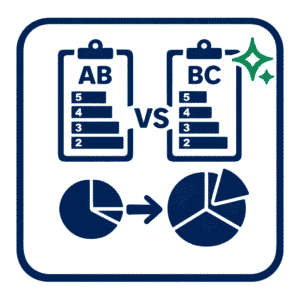
Context matters when comparing scores across Calculus AB and BC. A 4 on AB and a 4 on BC represent achievement at different curricular depths. BC covers additional topics such as infinite series and parametric equations, and its student population often enters with stronger preparation.
As a result, colleges sometimes treat BC scores differently. A score of 3 on BC may still grant placement equivalent to a higher AB score. This distinction explains why some students view a 3 on BC as good, while viewing the same score on AB as marginal.
Understanding this nuance helps avoid oversimplification when interpreting outcomes.
Raw performance versus scaled scores
AP scores do not correspond directly to percentage correct. Each exam year undergoes an equating process that adjusts score boundaries to maintain consistency across administrations.
As a result, earning a 5 does not require near-perfect performance. On many AP Calculus exams, students earning a 5 have answered correctly roughly two-thirds of the available points. This reality surprises many families and reframes expectations.
Using score calculators with caution
Online tools such as an ap calc score calculator or an ap calculus score calculator have become common. These tools estimate AP scores by combining correct multiple-choice responses with projected free-response points.
Their usefulness lies in planning rather than prediction. They allow students to test scenarios, such as how partial credit on free-response questions influences outcomes. Tools labeled ap calc ab score calculator or ap calc bc score calculator often incorporate historical cut score ranges.
Their limitation stems from uncertainty. Annual equating shifts, reader interpretation, and rubric nuance remain inaccessible. A calculator can approximate ranges, not certify results.
Psychological dimensions of “good”
While AP scoring remains technical, student perception adds a human layer. For a student aiming for selective STEM programs, a 3 may feel disappointing. For a first-generation student earning college credit, the same score may represent a major academic milestone.
The AP scale allows both interpretations to coexist. A good score reflects alignment between goals and outcomes, not universal rank.
This perspective aligns with the College Board’s stated intent that AP “provides willing and academically prepared students with the opportunity to pursue college-level studies” ( https://apcentral.collegeboard.org/about-ap).
The phrase “academically prepared” signals readiness rather than superiority.
Departmental expectations within colleges
Even within a single institution, AP Calculus scores may carry different weight depending on department. Mathematics departments often scrutinize calculus placement carefully, while social science departments may accept calculus credit more readily.
Engineering programs frequently set higher cutoffs, viewing calculus as cumulative and foundational. Liberal arts programs may prioritize breadth, granting credit for a wider range of scores.
These internal distinctions mean that a good score depends partly on a student’s intended academic path.
Historical stability of score meaning
Despite annual adjustments, the meaning of AP Calculus scores has remained stable over decades. Calculus AB debuted in the 1950s, with BC following later to reflect extended college sequences. The five-point scale has persisted throughout this period.
This continuity allows colleges to interpret scores consistently across cohorts. A 4 earned today carries similar implications to a 4 earned twenty years ago, even as curricula evolve.
Reframing success beyond the number
A single AP score captures performance on a single exam day. It does not capture growth, persistence, or future trajectory. Students who earn a 2 may still succeed in college calculus after structured instruction. Students earning a 5 may encounter challenges later.
From a mathematical standpoint, the score measures a bounded domain of knowledge. From an educational standpoint, it signals readiness rather than destiny.
Final Considerations
A good AP Calculus score resists a single definition. National data suggests that a 3 already reflects above-average performance. College credit policies often treat a 3 as a threshold and a 4 or 5 as acceleration. Research associates scores of 3 or higher with stronger college outcomes. Tools such as an ap calculus score calculator, ap calc score calculator, ap calc ab score calculator, or ap calc bc score calculator assist with estimation, yet they cannot replace institutional context.
The value of an AP Calculus score emerges at the intersection of preparation, goals, and opportunity. Within that intersection, “good” remains a standard shaped by evidence rather than assumption.