This tool lets you determine the pre‑tax price and the sales tax amount when you know the total paid and the tax rate.
According to the reverse sales tax formula, the pre‑tax price equals the total price divided by (1 + tax rate), and the tax amount is the pre‑tax price multiplied by the tax rate【42720160688958†L129-L133】.
Results:
Price before Tax: —
Sales Tax Amount: —
Sales tax calculations usually move in one direction. A price appears on a shelf, a percentage applies at checkout, and the total increases. Consumers and businesses grow accustomed to this forward motion. Yet many real situations run in reverse. A receipt shows only the final amount paid. An invoice lists a tax-inclusive total. A reimbursement policy caps spending after tax. In these moments, a different mathematical tool enters the picture: the reverse sales tax calculator.
This calculator answers a deceptively simple question. If the final price already includes sales tax, what was the original pre-tax amount, and how much tax did it contain? The arithmetic behind that question appears straightforward, yet misunderstandings remain common. Many people subtract tax percentages directly, an approach that quietly produces incorrect results. The correct method rests on proportional reasoning rather than subtraction.
This article examines the mathematics behind reverse sales tax calculators. It explains the reverse sales tax formula, walks through how to calculate reverse sales tax correctly, compares reverse sales tax vs regular sales tax, and situates these calculations within broader sales tax calculation methods used across the United States. Throughout, the discussion relies on verified tax data, historical context, and practical examples grounded in real policy structures such as sales tax rates by state and current US sales tax rates.
Why reverse sales tax calculations matter
Reverse sales tax calculations appear in everyday financial decisions.
A consumer returns an item and wants to confirm the refund breakdown. A business reimburses employees for tax-inclusive expenses. An accountant audits invoices that list only totals. A policymaker analyzes consumer prices that embed tax implicitly.
In each case, subtracting a tax percentage from the total fails. Sales tax adds proportionally to the base price, not linearly to the final amount. Reversing that process requires dividing rather than subtracting.
Reverse sales tax calculators formalize that logic. They protect against small numerical errors that scale into larger financial distortions over time.
The conceptual difference between forward and reverse tax
Forward sales tax follows a familiar structure.
Pre-tax price multiplied by one plus the tax rate equals the total price.
Reverse sales tax inverts that relationship.
Total price divided by one plus the tax rate equals the pre-tax price.
The tax amount equals the difference between the total and the pre-tax result.
This inversion defines the reverse sales tax formula. It relies on ratios, not differences. Treating sales tax as an additive surcharge rather than a multiplicative factor leads to consistent underestimation of the base price.
The reverse sales tax formula explained
The reverse sales tax formula uses three variables.
T represents the total price paid. r represents the sales tax rate expressed as a decimal. P represents the original pre-tax price.
The relationship follows.
P equals T divided by one plus r.
The tax amount equals T minus P.
For example, with a total of 108 dollars and a tax rate of 8 percent, the pre-tax price equals 108 divided by 1.08, which equals 100. The tax equals 8.
Subtracting 8 percent directly from 108 would yield 99.36, an incorrect base price. The difference may appear small in isolation. Over thousands of transactions, it compounds.
Reverse tax calculation relies on proportional reasoning rather than intuitive subtraction.
Why subtraction fails mathematically
Sales tax applies to the base price, not the final total. Subtracting a percentage from the total treats the tax as if it applied to itself.
In forward calculation, tax equals the base price multiplied by the tax rate.
In reverse calculation, the base price equals the total divided by one plus the tax rate.
These equations differ structurally. Subtraction ignores that structure.
This distinction explains why reverse sales tax vs regular sales tax calculations require different operations even though they involve the same percentage.
Historical context of sales tax structure
Sales tax entered widespread use in the United States during the Great Depression. States adopted consumption taxes as revenue sources when income and property tax bases weakened. Mississippi introduced the first statewide sales tax in 1930.
From the beginning, sales tax applied as a percentage of the sales price. That proportional design shaped accounting systems, legal definitions, and consumer pricing conventions.
The Federation of Tax Administrators documents this historical development and the continued reliance on percentage-based sales taxes across states through its overview of state sales tax rates.
Reverse calculations emerged naturally from this structure, even though consumer-facing tools lagged behind.
Sales tax calculation methods in practice
Sales tax calculation methods vary in presentation but share the same mathematical core.
Retailers calculate tax forward at the point of sale. Auditors calculate tax backward from receipts. Economists infer base prices from tax-inclusive consumption data.
Each method uses proportional relationships.
Reverse sales tax calculators automate backward inference. They perform a task long handled manually in accounting and economic analysis.
Sales tax rates by state and their role in calculations
Reverse calculations require accurate tax rates. Sales tax rates by state differ widely across the United States.
Some states levy no statewide sales tax. Others apply rates exceeding 7 percent. Many allow local jurisdictions to add additional percentages.
The Tax Foundation maintains updated tables of combined state and average local rates that summarize current US sales tax rates.
Reverse sales tax calculators often include state selection menus precisely because rates vary at multiple jurisdictional levels.
State sales tax rates and local complexity
State sales tax rates represent only part of the picture. Counties, cities, and special districts may impose additional taxes.
California’s statewide base rate combines with local add-ons, producing totals exceeding 10 percent in some areas. Colorado’s structure includes hundreds of local jurisdictions with distinct rates.
Reverse calculations require the combined rate, not the state base alone. Using an incomplete rate distorts results even when the formula remains correct.
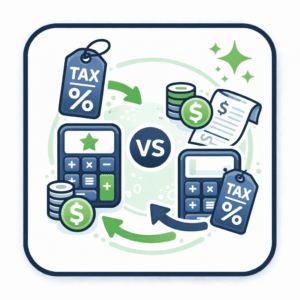
Regular sales tax versus reverse sales tax
Regular sales tax calculations answer a forward-looking question: how much will the final price be?
Reverse sales tax calculations answer a backward-looking question: what must the original price have been?
The difference lies in perspective rather than substance. Both use the same tax rate. Both rely on multiplication and division rather than addition and subtraction.
Applications in business accounting
Businesses rely on reverse calculations routinely.
Expense reimbursement policies often cap spending at tax-inclusive totals. Accounting departments must isolate pre-tax expenses and tax amounts for proper ledger classification.
Inventory valuation may rely on pre-tax cost even when invoices list only totals.
Reverse tax calculation allows consistent treatment across financial systems.
Reverse calculations in auditing and compliance
Auditors frequently encounter tax-inclusive figures without itemized breakdowns. Reverse sales tax calculations allow auditors to reconstruct taxable bases.
Tax authorities themselves use reverse calculations when examining consumer price data or verifying remittances.
This practice aligns with official definitions of taxable sales.
Economic analysis and price data
Economists analyzing consumer prices often work with tax-inclusive data. Reverse calculations remove tax effects to compare real consumption across regions with different rates.
The Bureau of Labor Statistics publishes consumer price data that exclude sales tax for certain analytical purposes, relying implicitly on reverse calculation logic.
Common mistakes in reverse sales tax calculations
Several errors recur frequently.
Subtracting tax percentages directly from totals. Using state base rates instead of combined rates. Rounding prematurely during division. Treating tax as a flat dollar amount.
Reverse sales tax calculators reduce these errors by enforcing correct structure.
Rounding and precision considerations
Reverse calculations often produce repeating decimals. Rounding policies matter.
Accountants typically round to the nearest cent after calculating the pre-tax amount, not during intermediate steps.
Premature rounding shifts tax amounts subtly. Over large datasets, these shifts accumulate.
Reverse calculations and consumer transparency
Consumers increasingly scrutinize receipts and pricing. Reverse sales tax calculations support transparency.
A customer verifying a refund expects the tax component to align with the original purchase. Reverse calculation confirms that alignment.
If a customer paid 54 dollars including an 8 percent tax, the pre-tax price equals 54 divided by 1.08, which equals 50. The tax refunded equals 4.
Refunding 8 percent of 54 would exceed the original tax collected.
Automated systems and reverse calculations
Modern point-of-sale systems perform reverse calculations automatically during returns. These systems embed the formula at the software level.
Reverse sales tax calculators mirror that embedded logic for manual verification.
Educational value of reverse sales tax
Reverse sales tax calculations offer a practical illustration of ratio-based reasoning taught in mathematics education.
They demonstrate why percentages operate multiplicatively and why inverse operations matter.
International perspectives
Value-added tax systems used internationally follow similar proportional logic. Reverse VAT calculations mirror reverse sales tax calculations structurally.
The Organisation for Economic Co-operation and Development describes VAT as a consumption tax levied as a percentage of value added at each stage of production in its explanation of what VAT is.
Policy analysis and tax incidence
Policy analysts examine who bears the burden of sales taxes by reversing tax-inclusive prices. Removing tax reveals underlying market prices.
This analysis informs debates about regressivity and consumer impact.
The limits of reverse sales tax calculators
Reverse sales tax calculators rely on correct inputs. An incorrect tax rate yields incorrect outputs regardless of formula accuracy.
They also assume a single combined rate. Complex transactions may require itemized analysis.
Why reverse calculations resist intuition
Human intuition favors subtraction. Percentages feel additive. Reverse sales tax calculations contradict that intuition.
Mathematics resolves the conflict through proportional reasoning.
Final Considerations
Reverse sales tax calculators formalize a simple yet frequently misunderstood mathematical inversion. They rely on the reverse sales tax formula rather than subtraction, reflecting the proportional nature of sales tax itself. Understanding how to calculate reverse sales tax clarifies why reverse tax calculation differs from forward methods and why reverse sales tax vs regular sales tax involves division rather than deduction.
Accurate use depends on correct sales tax rates by state and awareness of combined state sales tax rates within the broader landscape of US sales tax rates. When used thoughtfully, reverse sales tax calculators support transparency, accuracy, and consistency across consumer decisions, business accounting, and policy analysis. Their value rests not in complexity, but in mathematical honesty.