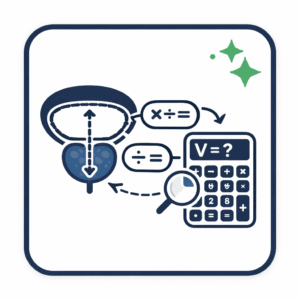
Estimate prostate volume using the ellipsoid formula:
Volume ≈ Length × Width × Height × 0.523
Results
Volume
— mL (≈ cc)
Volume
— in³
Note: 1 mL ≈ 1 cm³. This calculator is for educational/estimation use.
Prostate volume looks like a tidy fact: a single value in cubic centimeters that can be copied into a chart, inserted into a risk calculator, or used to justify a treatment plan. Yet the number often rests on a set of choices that stay invisible to the patient reading the report. The estimate may come from prostate volume ultrasound, a cross-sectional scan, or a worksheet inside an imaging console. It can be produced in seconds, then steer decisions for months.
That influence is not theoretical. Guideline documents and large studies repeatedly tie prostate size to clinical pathways: medication selection in benign prostatic hyperplasia, interpretation of prostate-specific antigen density, and procedural eligibility in radiotherapy planning. The data show a recurrent pattern: prostate volume matters, and measurement error is common. The public conversation tends to treat the number as a property of the body; the clinical reality treats it as a model of the body.
This report examines how prostate volume is calculated, why the prostate volume formula became the default, what prostate volume accuracy looks like when tested against reference standards, and how clinicians can lower avoidable error. It offers general information and cannot replace individual medical care.
Why Prostate Volume Carries So Much Weight
Volume is not a cosmetic statistic. It is used as a proxy for disease burden in benign enlargement, a denominator in PSA density, and a practical constraint in interventional planning. The European Association of Urology defines the concept succinctly: “Prostate-specific antigen density (PSA-D) is the level of serum PSA divided by the prostate volume.” (EAU Guidelines: Prostate Cancer, Diagnostic Evaluation)
That denominator can reshape risk estimates. In the same EAU chapter, one line captures how aggressively that ratio is used: “Patients with a PSA-D below 0.09 ng/mL/cc were found unlikely (4%) to be diagnosed with csPCa.” (EAU Guidelines: Prostate Cancer, Diagnostic Evaluation)
In benign prostatic hyperplasia, size stratifies risk and treatment response. A widely cited review of progression risk factors reports that digital rectal exam is a poor surrogate: prostate volume estimated by DRE “can underestimate measured volume by as much as 55%.” (PMC: Risk Factors for Clinical Progression of Benign Prostatic Hyperplasia)
When a rough bedside estimate can miss by half, imaging-derived volume becomes the default input for therapy choices.
The practical stakes extend into procedural care. A transrectal-ultrasound–based research group summarized the downstream effect with uncommon clarity: “patients might not be deemed candidates for brachytherapy or stereotactic body radiotherapy (SBRT) if prostate volumes are > 60 cc and > 80 cc, respectively.” (PMC: Prostate Volume Estimation using TRUS)
A number on a report can decide whether a patient is offered a technique at all.
The Standard Model: The Ellipsoid Prostate Calculation
Most routine measurements use an ellipsoid prostate calculation. The idea is simple: treat the gland as a 3D shape with three measurable diameters, then apply a geometric constant. Radiology Tutor describes the simplification in plain terms: “This can be simplified to 0.52(abc) because 0.52 = (4⁄3π)/2^3.” (Radiology Tutor: Prostate Ultrasound)
In clinic language, the constant is often written as 0.52 or 0.523.
A key investigative point: the ellipsoid assumption is a convenience, not a truth claim. The prostate is not a perfect ellipsoid, and its contours shift across ages, pathologies, and imaging angles. The model persists since it is fast, reproducible, and good enough for many decisions—until it is not.
TRUS Prostate Volume Calculation: What Gets Measured
Transrectal ultrasonography is often treated as the reference workhorse for volume estimation, partly from proximity and resolution. A peer-reviewed methods paper on ultrasound estimation states: “Ultrasonography, and more specifically transrectal ultrasonography (TRUS), is the most commonly used tool to estimate prostate volume.” (PMC: Prostate Volume Estimation using TRUS)
The same paper describes the computational heart of many machines: the ultrasonograph measures three dimensions and multiplies by a constant, “a coefficient of π/6 (0.52), also known as the prolate ellipsoid formula.” (PMC: Prostate Volume Estimation using TRUS)
That is the everyday trus prostate volume calculation that populates urology notes, PSA density estimates, and imaging follow-ups.
AIUM frames the acquisition goal in imaging language: “The prostate should be imaged in its entirety in at least two orthogonal planes… from the apex to the base of the gland.” (AIUM Practice Parameter (2025))
The phrase “in its entirety” hides the hard part: defining the boundary when the capsule is indistinct, the median lobe protrudes, or calcifications cast shadows.
A Practical Workflow With Fewer Unforced Errors
A clinician or sonographer cannot change anatomy, yet the measurement process can be tightened. A defensible workflow uses consistent planes, consistent caliper placement, and unit discipline.
A field-ready checklist for prostate volume ultrasound measurements:
Confirm units before calculation. Many scanners accept centimeters but output cubic centimeters (cc). Since 1 cc equals 1 mL, the value maps cleanly into clinical thresholds.
Use three orthogonal diameters. The AIUM standard embeds this structure in its formula statement (AIUM Practice Parameter (2025)).
Document how the “length” was obtained. Small differences in base-to-apex selection shift the final product.
Re-check for transcription errors. A one-digit mistake in a diameter propagates multiplicatively.
If PSA density is being used, compute it at the same sitting. PSA density is simple division, yet it is sensitive to volume drift (EAU Guidelines).
A patient may see “38 cc” in a report and treat it as a precise body measurement. The workflow above shows it is a computed estimate, with every caliper placement carrying weight.
Prostate Volume Accuracy: What Validation Studies Show
Accuracy claims need reference standards. Two recurring comparators appear in the literature: prostatectomy specimen volume and MRI-derived volume. A 2023 retrospective observational study compared transabdominal ultrasound (TAUS) and MRI against radical prostatectomy specimen volume, using the water-displacement method as reference. It reported: “The percentage error of PV measured by TAUS and MRI was within ± 20% in 65/106(61%) and 87/106(82%), respectively.” (PMC: Accuracy of prostate volume estimation using TAUS and MRI)
The same study quantified correlation strength: specimen volume correlated with TAUS (r = 0.838) and MRI (r = 0.914). Correlation is not equivalence; still, those numbers show MRI trending closer to the reference, with TAUS lagging as volume grows (PMC).
In prostates above 50 mL, MRI maintained strong correlation (r = 0.837), and TAUS dropped to moderate correlation (r = 0.665) (PMC).
TRUS has its own problem: systematic underestimation under common assumptions. A study using freshly resected prostates as reference reported that “the ellipsoid formula revealed an underestimation of the volume by a mean of 8.80 cc (18%).” (PMC: Prostate Volume Estimation using TRUS)
In the same dataset, a “bullet” model overestimated by 1.97 cc (4.6%) (PMC).
The key implication is not that one formula is universally superior. It is that the default ellipsoid method carries a directional bias in some settings, and that bias can be large enough to trip clinical cutoffs.
Radiology Tutor summarizes the same theme in a single sentence: “It has been shown that the ellipsoid formula underestimates prostate size in transrectal sonography.” (Radiology Tutor)
Measurement Limitations That Commonly Distort the Result
The term measurement limitations is often treated as boilerplate. In this domain, it is an operational warning. Several failure modes recur across ultrasound and MRI workflows.
Shape mismatch. The prostate is not reliably ellipsoid. Benign enlargement can create asymmetric lateral lobes; cancer and inflammation can distort margins. The ellipsoid prostate calculation does not “see” those details; it averages them away.
Boundary ambiguity. Ultrasound depends on echogenic contrast. The capsule is not always crisp. The operator may include periprostatic tissue or exclude protruding lobes.
Probe pressure and deformation. TRUS can compress tissue and change apparent dimensions. The effect is subtle yet systematic in some hands.
Plane selection drift. “Length” can shift with slight tilts. A millimeter-scale change compounds through multiplication.
Large-gland penalty. The TAUS vs MRI vs specimen study suggests error behavior changes in larger prostates, with TAUS correlation dropping in volumes above 50 mL (PMC).
A blunt investigative takeaway: two clinics can measure the same gland and produce different volumes without malpractice, simply through different acquisition habits and different shape assumptions.
Clinical Significance Prostate Volume: How the Number Alters Decisions
The clinical significance prostate volume shows up in medication choice, cancer work-up, and procedural planning.
Benign Prostatic Hyperplasia And Medication Response
The threshold logic in guideline-aligned care is visible in open-access guidance. A Canadian urology guideline update states: “Efficacy is noted in patients with a prostate volume >30 cc (and/or PSA levels >1.5 ng/ml).” (PMC: Canadian Urological Association guideline update)
Size and PSA relationships are also used for progression risk. A review of progressive BPH reports that men with PV ≥ 30 mL are more likely to face severe symptoms and acute urinary retention, with three- to fourfold AUR risk compared with PV < 30 mL (PMC: Risk Factors for Clinical Progression of BPH).
That is where prostate size meaning becomes tangible: it is not a label, it is a risk stratifier.
PSA Density And Biopsy Pathways
The EAU guideline notes a commonly used PSA-D cutoff of 0.15 ng/mL/cc in risk stratification (EAU Guidelines).
Yet the evidence base for a single threshold is being re-litigated. A 2023 paper focused on the “0.15” cutoff reported: “There was no discontinuity in the risk of high-grade prostate cancer at a PSAd cutoff of 0.15.” It then stated: “We recommend a value of at least ≥0.20.” (PMC: PSA density cut-off study)
That debate loops back to measurement: PSA density is only as stable as the volume denominator. A patient can cross a threshold on paper without any biological change, simply through a different imaging method or a different operator.
Prostate Volume Calculator Tools: Useful, Yet Easy To Misuse
Online prostate volume calculator and prostate size calculator tools now appear in radiology cheat sheets, urology blogs, and clinical utilities. Some are responsible and transparent, replicating standard formulas and warning about assumptions. A core risk remains: users can enter millimeters into a calculator built for centimeters, then generate volumes off by a factor of 1,000.
A practical verification method is simple:
Confirm the tool states the formula and the constant (0.52 or 0.523).
Confirm the expected unit for each diameter.
Cross-check one example manually with a calculator.
Use the same calculator for follow-up visits to reduce method drift.
When patients ask why two reports show different sizes, the honest answer is not that the gland “changed.” The answer is that the prostate volume formula models a complex organ with a simplified geometry, and small choices move the output.
Final Considerations
The calculation of prostate volume is not a side detail. It is a decision input with real consequences: drug response expectations, PSA density interpretation, and procedural eligibility can shift with a difference of a few cubic centimeters. The literature shows consistent themes: ellipsoid methods are fast and standardized; TRUS measurements can underestimate in some contexts; TAUS loses accuracy as glands enlarge; MRI trends closer to specimen references in at least one prostatectomy-based comparison.
A better standard of care is not endless complexity. It is explicitness: stating the method, keeping units consistent, and treating borderline thresholds as prompts for re-checking rather than as verdicts. When volume is used to justify a major step—biopsy strategy, radiotherapy technique, or long-term medication—an extra minute spent on measurement discipline can spare a patient from months of avoidable uncertainty.