Prostate Volume By Ultrasound: How A Three-Number Estimate Ends Up Steering Care
By Paul Newton, January 3, 2026
A prostate volume ultrasound report can look disarmingly simple: a single number in cubic centimeters (cc), sometimes paired with “mild,” “moderate,” or “enlarged.” Patients often treat that value as a direct physical fact, like height. Clinicians know it behaves more like a calculated model—fast, useful, imperfect, and sensitive to technique. The calculation of prostate volume sits inside decisions that patients feel immediately: which medicines get offered for urinary symptoms, how PSA results get interpreted, and which procedures remain on the table.
The American Institute of Ultrasound in Medicine (AIUM) puts prostate ultrasound into a standards framework that reveals what the exam is expected to deliver. In its 2025 practice parameter, AIUM states: “The transrectal approach to prostate ultrasound is the method of choice because the resulting image quality is superior to transabdominal and transperineal examinations.” It adds: “A transabdominal approach can estimate prostate size in some settings.” (AIUM Practice Parameter for the Performance of an Ultrasound Examination of the Prostate (2025))
Those two sentences capture the modern bargain: the least invasive route may be acceptable for an estimate; the more invasive route tends to deliver higher-fidelity images.
This article examines prostate volume measurement by ultrasound with the cold eye of an audit: what gets measured, which formula dominates, where error enters, and which steps reduce avoidable drift. It offers general information, not individual medical advice.
What Ultrasound Is Trying To Measure
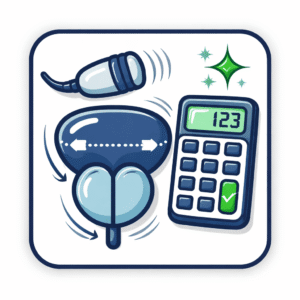
Ultrasound does not measure volume directly. It measures dimensions and infers volume from geometry. AIUM describes the acquisition expectation: “The prostate should be imaged in its entirety in at least two orthogonal planes… from the apex to the base of the gland.” (AIUM Practice Parameter (2025))
The word “entirety” hides the practical challenge: the gland boundary does not always show crisp edges, and anatomy varies.
Clinically, the number matters more than it should when it becomes a threshold. Size categories influence benign prostatic hyperplasia (BPH) medication strategy. PSA density uses volume as a denominator. Radiotherapy workflows may apply volume cut points for technique selection. A patient’s lived experience often begins with symptoms; the chart begins with measurements.
The Default Prostate Volume Formula: The Ellipsoid Assumption
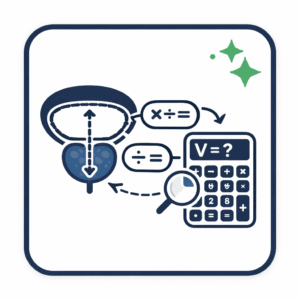
Most ultrasound consoles produce volume via an ellipsoid model. AIUM states the standard explicitly: “An estimated volume is determined from measurements in three orthogonal planes (volume = length × height × width × 0.52).” (AIUM Practice Parameter (2025))
That constant (0.52) comes from ellipsoid geometry. Radiology Tutor explains the simplification: “This can be simplified to 0.52(abc) because 0.52 = (4⁄3π)/2^3.” (Radiology Tutor: Prostate Ultrasound)
The model works best when the organ behaves like the model. The prostate often does not. Benign enlargement can alter contours; median lobe protrusion can distort “base” selection; probe pressure can change shape in real time. The ellipsoid method survives since it is quick, reproducible, and easy to teach. It can still mislead near clinical cutoffs.
TRUS Prostate Volume Calculation: Why It Remains The Workhorse
Transrectal ultrasound (TRUS) sits close to the gland, which supports higher-resolution imaging. AIUM calls it the “method of choice” for image quality. (AIUM Practice Parameter (2025)) In practice, TRUS volume often becomes the reference estimate for urology clinics, biopsy planning, and BPH work-up.
A recurring technical point: even TRUS can mis-measure if calipers chase convenience rather than maximal diameters. A classic study summary on PubMed states: “This study confirms that to estimate accurately the volume of the prostate using the prolate ellipsoid formula, the current methodology needs to be changed.” It then recommends measuring the largest diameters across different slices: “The largest anteroposterior and transverse diameters may need to be measured in different transverse scan slices and the largest craniocaudal diameter in a sagittal scan away from the midline.” (PubMed)
That is not a subtle critique. It says routine habits can systematically miss true maximal dimensions.
A TRUS Measurement Sequence That Matches Standards
AIUM sets minimum structural expectations:
Two orthogonal planes, covering apex to base
Three orthogonal measurements for the volume formula
A field-ready sequence that aligns with those expectations:
Survey sweep: confirm the apex and base in sagittal view.
Length: measure craniocaudal diameter with deliberate base and apex selection.
Width and height: measure transverse dimensions on the slice where each diameter peaks, not where the image looks most symmetrical. The Nathan et al. recommendation supports this approach (PubMed).
Record the method: document TRUS vs transabdominal ultrasound (TAUS), then document whether ellipsoid or planimetry was used.
Transabdominal Ultrasound: A Practical Estimate With Known Tradeoffs
TAUS avoids an endorectal probe. That can improve acceptability in primary care or in patients who cannot tolerate TRUS. AIUM’s 2025 parameter acknowledges the niche: “A transabdominal approach can estimate prostate size in some settings.” (AIUM Practice Parameter (2025))
The catch is not incompetence; it is physics. TAUS must image through the abdominal wall and a partially filled bladder with variable acoustic windows. That can blur the gland boundary and shift caliper placement.
When TAUS is used, the report still tends to present a single number with the same clinical implications. That mismatch—lower-fidelity imaging paired with high-stakes interpretation—drives the need for accuracy data.
Prostate Volume Accuracy: What Studies Show When Ultrasound Meets Reference Standards
Accuracy needs a comparator. Many studies use prostatectomy specimen volume as a reference, with MRI and ultrasound as index methods.
A 2023 retrospective study comparing TAUS and MRI against radical prostatectomy specimen volume reported: “The percentage error of PV measured by TAUS and MRI was within ± 20% in 65/106(61%) and 87/106(82%), respectively.” (PMC)
That result signals two things:
A TAUS estimate falls outside ±20% in about four out of ten cases in that cohort.
MRI performed closer to the specimen reference in that cohort.
The same study reports correlation details that matter for larger glands: “In patients with PV greater than 50 ml, MRI volume still correlated strongly with specimen volume (r = 0.837… ), while TAUS volume showed only moderate correlation with specimen (r = 0.665…).” (PMC)
TRUS has a different failure mode: systematic underestimation in many routine ellipsoid implementations. A 2008 Journal of Urology study summary on PubMed reported: “Transrectal ultrasound underestimated it by greater than 30% in 55% of cases and overestimated (greater than 10%) it in only 6.4%.” (PubMed)
That asymmetry—many large underestimates, few large overestimates—matters. Underestimation can inflate PSA density and can push a patient across a decision threshold on paper.
When The Ellipsoid Model Fails: Shape, Lobes, And Boundary Judgment
Radiology Tutor’s prostate volume calculator page gives a blunt warning: “It has been shown that the ellipsoid formula underestimates prostate size in transrectal sonography1,2.” It then points to an alternate shape model used in a brachytherapy population: “a bullet shape may better reflect the shape of the prostate” and gives a different constant: “0.65(lwh).” (Radiology Tutor)
A single constant change sounds small. It can shift eligibility when a clinical pathway uses cut points like 30 cc, 60 cc, or 80 cc.
AIUM signals a higher-accuracy path that avoids rigid shape assumptions: “prostate planimetry… allows greater accuracy of prostate volume by accommodating individual variations in prostate shape.” (AIUM Practice Parameter (2025))
Planimetry takes more time, and it depends on software and operator training. It exists as an option in the standard, which matters for cases where volume precision carries extra weight.
Measurement Drift: Common Sources Of Error In Prostate Volume Ultrasound
Even skilled operators can generate different volumes from the same gland. The error often comes from process, not intent.
Frequent drivers of drift:
Plane selection drift: a slight probe angle change can shift the apparent apex or base.
Largest diameter hunting: convenience slices tend to look symmetric; maximal diameter slices may look messy.
Median lobe inclusion: base definition can shift when the gland protrudes into the bladder.
Capsule ambiguity: TAUS can blur the outer boundary, inviting under-measurement.
Deformation from probe pressure: TRUS can alter geometry during measurement.
The operational remedy is standardization: measure the largest diameters where they truly occur, even if that forces measurements across different slices. Nathan et al. calls this out directly. (PubMed)
Why Clinicians Use The Number Anyway: PSA Density And BPH Decisions
The volume estimate becomes clinically powerful when paired with PSA. The European Association of Urology defines the metric: “Prostate-specific antigen density (PSA-D) is the level of serum PSA divided by the prostate volume.” (EAU Guidelines) It then ties PSA-D to risk: “Patients with a PSA-D below 0.09 ng/mL/cc were found unlikely (4%) to be diagnosed with csPCa.” (EAU Guidelines)
A simple ratio can swing when volume changes by 10–20%. That is not rare in ultrasound-based estimates, per the TAUS ±20% data and the TRUS underestimation pattern. (PMC; PubMed)
Volume influences BPH therapy selection in guideline language. A Canadian Urological Association guideline update states: “Efficacy is noted in patients with a prostate volume >30 cc (and/or PSA levels >1.5 ng/ml).” (PMC)
That sentence links an imaging estimate to expected medication benefit, particularly for 5-alpha reductase inhibitor therapy.
A Practical Prostate Volume Measurement Checklist
This checklist targets the most avoidable errors without turning a routine study into a research project.
For Clinicians And Sonographers
State the approach: TRUS vs TAUS. AIUM frames TRUS as image-quality superior (AIUM).
Use the three-plane standard: AIUM’s formula requires three orthogonal dimensions (AIUM).
Chase maximal diameters: measure AP and transverse peaks even if they sit on different transverse slices; measure craniocaudal peak away from midline when needed (PubMed).
Record the formula: ellipsoid constant 0.52, or a different model if used.
Flag shape anomalies: large median lobe, irregular contour, poor capsule definition. Consider planimetry when precision carries extra weight (AIUM).
For Patients Reading Their Report
Ask which approach was used: TRUS or TAUS.
Ask which method generated the number: ellipsoid or planimetry.
Ask whether the same method will be used at follow-up, since trend interpretation depends on consistent technique.
Ask how the measurement interacts with PSA density if PSA-D is being used in a decision (EAU Guidelines).
A patient does not need to master ultrasound geometry. A patient benefits from knowing the estimate has assumptions.
Final Considerations
Prostate volume by ultrasound is an estimate built from three dimensions and a model constant, most often the ellipsoid equation that AIUM expresses as “length × height × width × 0.52.” (AIUM)
The number can be clinically decisive, yet the evidence shows meaningful error rates: a TAUS estimate fell within ±20% of specimen volume in 61% of cases in one prostatectomy-based cohort, and MRI reached 82% in that same cohort. (PMC)
TRUS ellipsoid workflows can show a strong underestimation bias, with one study summary reporting underestimation greater than 30% in 55% of cases. (PubMed)
A reliable path forward does not require perfection. It requires transparency, repeatable technique, and restraint near thresholds. When a treatment decision leans heavily on a borderline volume, the report deserves a second look at the prostate volume measurement process itself—plane selection, maximal diameter selection, and shape fit. Ultrasound remains a practical tool. Its value rises when its assumptions stay visible.