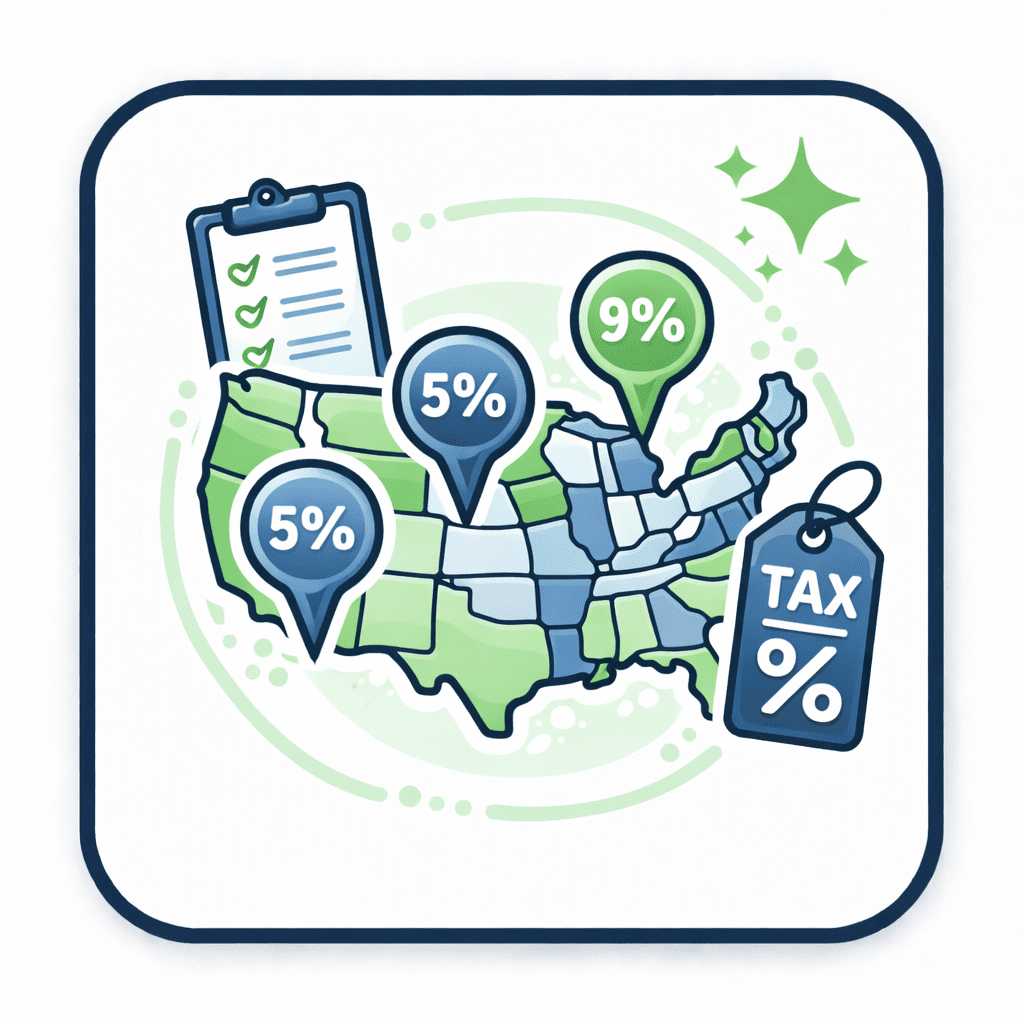
Sales tax can look simple on a receipt: a subtotal, a percentage, a final total. Yet “sales tax rates by state” rarely means a single number that applies everywhere inside a state. In most states, the tax charged at checkout combines at least two layers: a statewide rate plus one or more local add-ons. That structure turns a tidy headline rate into a moving target that changes by address, product category, and date.
One reason people get frustrated is that the math feels like it should be uniform. A percentage is a percentage. Still, sales tax is a policy tool as much as a calculation, and the calculation follows the policy’s boundaries: jurisdictions, exemptions, caps, and effective dates.
A useful starting point is the Sales Tax Institute’s rate chart, which states: “The following chart lists the standard state level sales and use tax rates (as of 2/1/2026)” and adds that “Sales and use tax rates change on a monthly basis.” Those two sentences quietly explain most real-world confusion. A rate table is time-stamped, and a state’s “rate” often hides local variation. ( Sales Tax Institute’s rates chart) (salestaxinstitute.com)
What “by state” measures, in math terms
In pure arithmetic, sales tax is a proportional increase:
tax = taxable amount × rate
total = taxable amount + tax
The difficulty sits inside “rate” and sometimes inside “taxable amount.”
A statewide rate is the part enacted at the state level. Many states allow counties, cities, transit districts, or special districts to add local rates. That means a state can publish a rate while a consumer experiences a different one at checkout.
Texas makes the structure explicit: “The Texas state sales and use tax rate is 6.25 percent, but local taxing jurisdictions (cities, counties, special-purpose districts and transit authorities) also may impose sales and use tax up to 2 percent for a total maximum combined rate of 8.25 percent.” ( Texas Comptroller local tax FAQ) (comptroller.texas.gov)
California gives a different version of the same idea: “The statewide tax rate is 7.25%.” Then it notes that district taxes can stack on top: “Those district tax rates range from 0.10% to 2.00%.” ( CDTFA sales and use tax rate information) (cdtfa.ca.gov)
So a “state rate” is often the floor, not the lived rate.
A grounded range: how far state rates spread
As of 2/1/2026, the Sales Tax Institute chart lists state-level sales and use tax rates from 0.000% (no general statewide sales tax) up to 7.250% (California). It lists several states at 7.000%: Indiana, Mississippi, Rhode Island, and Tennessee. (salestaxinstitute.com)
That range can tempt a quick ranking: “high-tax states” versus “low-tax states.” The math pushes back. A state with a modest state rate can still allow wide local add-ons, producing high combined rates in many places. Another state can post a high state rate while limiting local variation.
A small snapshot shows why comparisons need context:
Example jurisdiction
State rate shown
Local range shown (selected states)
Colorado
2.900%
0%–8.3% (salestaxinstitute.com)
Alabama
4.000%
0%–9.0% (salestaxinstitute.com)
New York
4.000%
0%–5% (salestaxinstitute.com)
Texas
6.250%
0%–2% (salestaxinstitute.com)
California
7.250% (base shown)
local district taxes vary (cdtfa.ca.gov)
The point is not that one state is “better.” It is that the rate a person pays is the outcome of layers.
The local layer: why the same state can feel like two different states
Local sales taxes exist for a practical reason: they fund local services and let local governments adjust revenue without waiting for the state legislature. The cost is complexity, and complexity has measurable consequences: misquotes at the register, mismatched invoices, and erroneous comparisons across addresses.
The math itself stays stable; the inputs change.
A simple example illustrates the sensitivity. Take a $249.99 taxable purchase.
At 6.25%, tax = 249.99 × 0.0625 = 15.624375 → typically rounded to $15.62 or $15.63 depending on jurisdiction rules.
At 8.25%, tax = 249.99 × 0.0825 = 20.624175 → about $20.62 or $20.62/$20.63.
That is a ~$5 swing on one mid-priced item, driven by local variation, not by a change in the underlying arithmetic.
This is where small, quiet details matter:
rounding rule (line-item rounding vs invoice-level rounding)
taxable base (some items exempt, partially taxed, or taxed at special rates)
sourcing rule (rate based on origin vs destination, common in remote sales contexts)
Rate comparisons that ignore those elements can be numerically correct and still misleading.
Five states with no general sales tax, and the footnotes people skip
“Zero sales tax” gets repeated in casual conversation as if it means “no consumption tax of any sort.” The official language is narrower: no general statewide sales tax, with other taxes still present.
Official state guidance makes the distinctions plain:
The math implication is straightforward: “0% state sales tax” does not imply “0% tax on spending.” It implies that the standard general sales tax mechanism is absent at the state level.
Rates change: the calendar matters as much as the percentage
Sales tax is not a static parameter. Governments update rates, create new districts, and sunset temporary levies. That makes the date part of the calculation.
Illinois’ Department of Revenue states: “Effective January 1, 2026, certain taxing jurisdictions have imposed a local sales tax or changed their local sales tax rate on general merchandise sales.” It adds a practical directive: “You must adjust your cash register and any computer program so that beginning on January 1, 2026, you will collect and pay the correct sales tax.” ( Illinois IDOR bulletin FY 2026-10-A) (tax.illinois.gov)
That reads like compliance guidance, yet it doubles as consumer advice: a “rate by state” table is a snapshot, not a permanent truth.
The math mistakes that distort “by state” comparisons
Many errors are not advanced math problems. They are category errors.
Confusing state rate with combined rate A state rate is not the total when local add-ons apply.
Treating the rate as the only variable Taxability rules can shift the taxable base, which can matter more than a one-point rate difference.
Comparing receipts across different product mixes Groceries, clothing, prepared food, and services can be treated differently across states.
Forgetting rounding behavior Rounding at the line level can create small differences that accumulate in bulk transactions.
These mistakes create a pattern: people argue about “the rate” when the actual computation uses several rate-like inputs and a taxability definition.
Reverse sales tax: backing out the pre-tax price without self-deception
Reverse calculation shows up in returns, reimbursements, expense audits, and marketplace payouts. The goal is to recover the pre-tax amount from a tax-included total.
If total = base × (1 + rate), then:
base = total ÷ (1 + rate)
tax = total − base
Example: total paid = $108.25, combined rate = 8.25% (0.0825)
base = 108.25 ÷ 1.0825 = 100.00
tax = 108.25 − 100.00 = 8.25
Reverse problems fail when the wrong rate gets used. This is where tools can help, as long as the rate input is correct. Many people reach for a reverse sales tax calculator, a reverse tax calculator, or a sales tax reverse calculator, then trust the output too quickly. The calculator can only mirror the assumptions fed into it. A local district change, a capped local rate, or a category-specific rate can break the result even when the arithmetic is perfect.
Why these rates matter beyond the receipt
Sales taxes fund public services, and the mix differs across states. The public finance side explains why rate design varies so much.
Pew’s analysis of state tax collections states: “In fiscal year 2023, two-thirds of states’ total tax dollars came from levies on personal income (33.1%) and on general sales of goods and services (32.3%).” ( Pew: how states raise their tax dollars, FY 2023) (pew.org)
When a state leans more on sales taxes, its rate design often becomes a political statement about who pays, when, and on what kinds of purchases. Exemptions and reduced rates can soften burdens on common necessities, yet they can narrow the base and pressure lawmakers to raise rates elsewhere. That tradeoff shows up in the math as more exceptions, not as harder multiplication.
A practical way to use “sales tax rates by state” without getting burned
A consumer, business owner, or analyst can treat rate tables as navigation tools, not as final answers.
A tight workflow helps:
Use a state-level table to get the baseline rate and the local range.
Identify the exact place of sale or delivery address; local rates can be address-dependent.
Confirm whether the item category carries special treatment (reduced rate, exemption, or special district rules).
Keep the transaction date visible; rate changes often cluster around January 1 and July 1.
When reversing tax from an all-in price, verify the combined rate first, then compute the base.
This is not a call for paranoia. It is respect for the fact that sales tax is applied by jurisdictions, not by vibes.
Final Considerations
A “sales tax rate by state” can be a valid statistic and still be the wrong number for a real transaction. The arithmetic stays calm, yet the inputs move: local layers, district taxes, product rules, and effective dates.
The most reliable approach treats sales tax like a coordinate system. State rate sets the broad location; the address and category pin down the point. When reverse calculations enter the picture, the rate choice matters as much as the division.
Sales tax math rewards a certain posture: patient, literal, and alert to small print. That posture turns a confusing receipt into a readable one, and it turns a rate table from trivia into a tool.