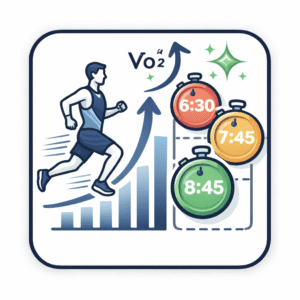
A Metric Born From the Limits of Traditional Physiology
Distance running has always wrestled with measurement. Race times fluctuate with weather, terrain, and tactics. Heart rate drifts under fatigue. Laboratory VO₂ max testing, long treated as a gold standard, demands specialized equipment and often fails to predict real-world performance accurately. Against this backdrop, VDOT emerged as an attempt to reconcile physiology with outcomes observed on the road and track.
The concept originates with Jack Daniels, an exercise physiologist whose work with elite athletes and Olympic teams revealed a persistent gap between laboratory metrics and competitive results. Daniels addressed this gap directly: “VDOT is not VO₂ max. It is an estimate of the aerobic ability required to run a given performance.” https://runsmartproject.com
That statement captures the essence of VDOT. It reframes fitness as something inferred from performance rather than measured in isolation.
Defining VDOT Without the Abstraction
VDOT represents an index number that corresponds to the oxygen demand of running at a specific speed. Higher values reflect the ability to sustain faster paces aerobically. Unlike raw VO₂ max, VDOT incorporates running economy, acknowledging that athletes differ in how efficiently they convert oxygen into forward motion.
When athletes ask what VDOT means, the most accurate explanation focuses on function. VDOT translates a race result into a standardized measure of aerobic performance potential. The number itself carries no units. Its meaning emerges only through comparison, trend analysis, and application to training structure.
This framing explains why a runner with a lower laboratory VO₂ max may outperform another athlete with a higher value. Daniels addressed this directly in academic literature, noting that oxygen cost at race pace varies widely among runners with similar physiological ceilings. https://journals.lww.com
Historical Context and Adoption
VDOT gained prominence during the expansion of recreational road racing in the late twentieth century. As participation surged, athletes sought guidance that balanced scientific grounding with practical accessibility. Daniels’ work offered a solution grounded in observed performance rather than laboratory exclusivity.
The publication of Daniels’ Running Formula introduced tables linking race performances to training paces. These tables formed the backbone of what later became the modern vdot calculator. Adoption spread through coaching networks, collegiate programs, and self-coached runners seeking structure without constant testing.
Its endurance reflects usability rather than novelty. VDOT persists across decades where other training fads faded quickly.
How the VDOT Calculator Works
A vdot calculator operates through reverse inference. The athlete inputs a recent race time and distance. The calculator estimates the oxygen demand required to sustain that performance and assigns a corresponding VDOT value.
This process rests on two empirically derived relationships:
The oxygen cost of running at a given velocity
The fraction of aerobic capacity sustainable over time
Daniels derived these relationships from decades of performance data and metabolic testing. The equations model how oxygen consumption increases as speed rises and how fatigue limits sustainable effort as duration lengthens.
The resulting VDOT number serves as a reference point. It anchors training paces, informs race prediction, and tracks fitness changes over time.
Peer-reviewed research supports this structure. A study published in Medicine & Science in Sports & Exercise reported strong correlations between VDOT-derived predictions and actual race performances across distances from 1500 meters to the marathon.
https://journals.lww.com
Why VDOT Differs From VO₂ Max
VO₂ max measures maximal oxygen uptake under controlled laboratory conditions. VDOT estimates the oxygen requirement of a real-world performance. The distinction matters.
Laboratory testing captures capacity under idealized protocols. Racing introduces pacing decisions, terrain variability, psychological stress, and biomechanical efficiency. VDOT absorbs these influences by grounding its estimate in outcome rather than potential.
Daniels summarized this distinction succinctly: “Running economy matters. Some runners use less oxygen to run the same pace, and VDOT accounts for that.”
https://journals.lww.com
Using VDOT to Structure Training
The practical power of VDOT lies in its translation into training paces. Once an athlete calculate vdot, that value maps directly onto defined intensity zones.
Daniels outlined several standardized categories:
Easy (E): aerobic development and recovery
Marathon (M): sustained aerobic endurance
Threshold (T): lactate clearance capacity
Interval (I): high-level aerobic stimulation
Repetition (R): neuromuscular efficiency and speed
Each pace range corresponds to a percentage of VDOT. These percentages align training intensity with specific physiological adaptations. The system removes ambiguity from daily sessions, replacing subjective effort guesses with performance-calibrated guidance.
Research supports this stratification. Threshold training near lactate steady state improves endurance performance without disproportionate fatigue accumulation, a finding replicated across endurance literature. https://www.ncbi.nlm.nih.gov
VDOT as a Tool for Consistency
One of VDOT’s understated strengths lies in internal coherence. All training paces derive from a single anchor performance. This coherence reduces conflicting signals that arise when heart rate, perceived effort, and pace targets disagree.
Heart rate responds to heat, hydration, and fatigue. Pace remains objective. VDOT aligns pace targets with current fitness, preserving relevance across conditions when applied with judgment.
Coaches frequently emphasize restraint. Training at prescribed paces rather than aspirational ones limits overreach. Daniels warned against intensity drift: “Each pace has a purpose. Training at the wrong pace compromises the intended adaptation.”
https://runsmartproject.com
Tracking Fitness Changes Over Time
VDOT functions as a longitudinal metric. Repeating race performances under similar conditions reveals fitness trends. Rising VDOT values indicate improved aerobic performance capacity. Declines signal fatigue, detraining, or external stressors.
Small fluctuations carry limited meaning. Meaningful change emerges over weeks or months. Updating VDOT after every minor race risks overfitting training to noise rather than signal.
Elite programs often reassess VDOT at defined intervals, aligning adjustments with training phases rather than race frequency.
VDOT and Race Prediction
Beyond training, VDOT supports race prediction across distances. Input a recent performance, and the calculator estimates equivalent results at other distances.
Validation studies suggest moderate accuracy when predictions remain within similar physiological domains. Short-to-short or long-to-long projections perform better than extreme extrapolations.
A review in International Journal of Sports Physiology and Performance reported prediction errors typically within 2–4% for well-trained runners using recent race data. https://journals.humankinetics.com
Prediction assumes balanced preparation. Athletes lacking endurance depth may underperform longer-distance projections. Speed-limited runners may struggle with shorter predictions.
Limitations That Shape Interpretation
VDOT rests on assumptions that merit scrutiny:
Even pacing under race conditions
Adequate preparation for the predicted distance
Neutral environmental conditions
VDOT does not incorporate:
Strength deficits
Injury history
Psychological variability
Course elevation profiles
These omissions do not invalidate the metric. They define its boundaries. Daniels acknowledged these limits openly, noting that VDOT reflects potential only when training supports realization.
https://runsmartproject.com
Integration With Modern Technology
Wearables now deliver continuous pace, heart rate, and power data. VDOT integrates within this ecosystem rather than competing with it.
Many platforms overlay VDOT-based pace targets alongside heart rate zones or power ranges. Coaches use VDOT to cap intensity, preventing accumulation of unplanned stress.
Power measures output. Heart rate reflects physiological response. VDOT anchors expectation. Combined, they form a triangulated control system.
Practical Guidance for Athletes and Coaches
Effective use of VDOT follows disciplined practice:
Base calculations on recent, well-paced races
Avoid tactical or uneven events
Adjust VDOT only after meaningful performance change
Treat pace ranges as flexible boundaries
Consistency outweighs precision. A stable reference supports adaptation better than constant recalibration.
For coaches managing groups, VDOT allows individualized pacing within shared sessions. Each athlete trains relative to capacity rather than group averages.
Final Considerations
VDOT represents an effort to bridge physiology and performance without laboratory dependence. Its durability reflects empirical grounding and practical relevance rather than theoretical elegance.
Understanding what VDOT represents begins with recognizing its role as an interpretive index, not a physiological measurement. A vdot calculator simplifies arithmetic, yet insight arises from context and restraint.
When athletes calculate vdot thoughtfully and apply it consistently, the metric offers a reliable framework for structuring training, monitoring progress, and setting realistic expectations grounded in evidence rather than intuition.