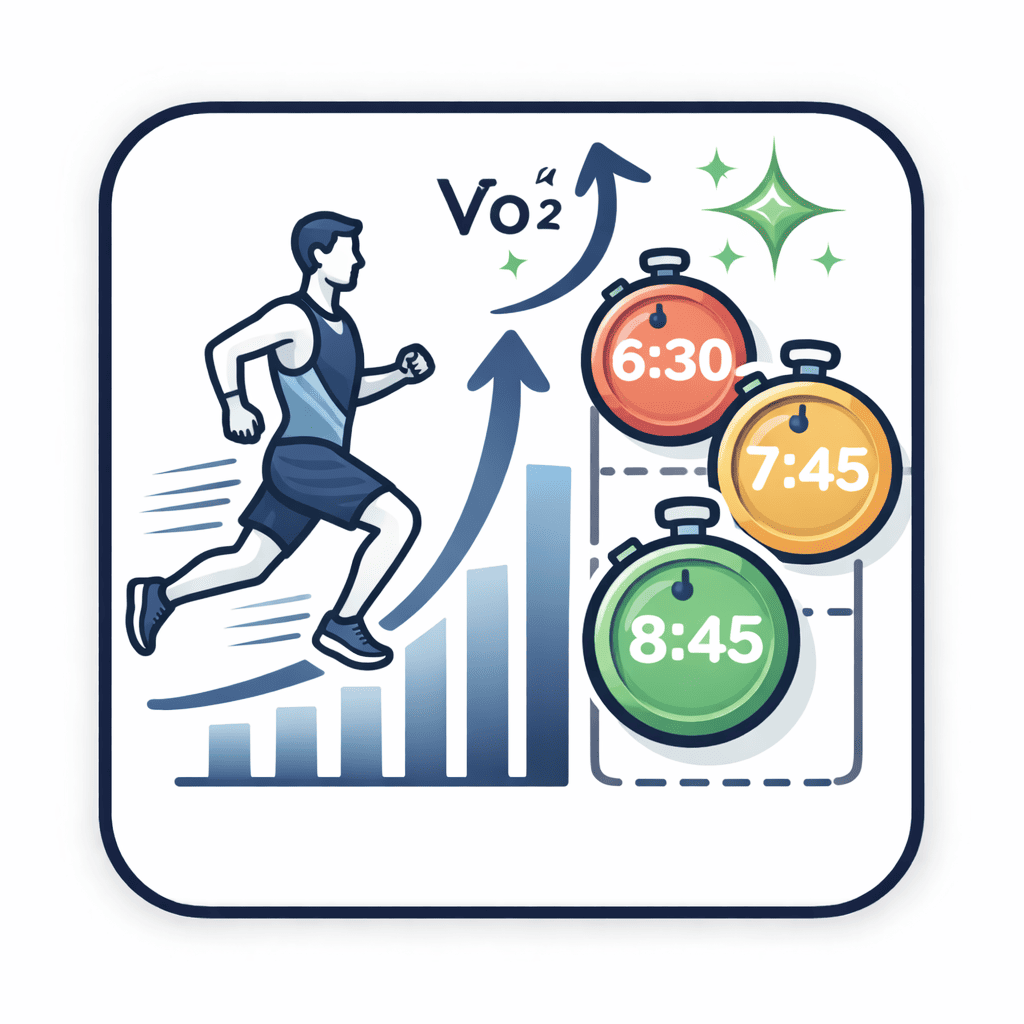
Endurance training often fails not from lack of effort, but from misdirected intensity. Recreational and competitive runners alike tend to accumulate fatigue at speeds that feel productive yet deliver limited adaptation. VDOT training paces emerged as a response to that pattern, offering a structured way to align daily running speeds with specific physiological outcomes.
Rather than prescribing effort by feel alone, VDOT training paces anchor intensity to demonstrated performance. They derive from an athlete’s recent race result, translated through a vdot calculator into a single index number. From that number flows a full spectrum of training speeds, each designed to target a distinct system.
This approach reframed endurance training from intuition-driven to evidence-informed, without requiring laboratory testing or continuous physiological monitoring.
Origins of the VDOT Pace System
The VDOT framework originates with Jack Daniels, an exercise physiologist whose work with Olympic athletes highlighted persistent mismatches between training intensity and intended adaptation. Daniels observed that many athletes trained too fast on easy days and too slow on quality days, blurring stimulus and recovery.
Daniels articulated the premise succinctly: “Each pace has a purpose. Training at the wrong pace compromises the intended adaptation.” https://runsmartproject.com
That statement underpins the entire VDOT pace structure. Each pace exists to stress a defined physiological mechanism, not to satisfy arbitrary mileage or perceived effort.
How VDOT Training Paces Are Derived
VDOT training paces originate from race performance rather than physiological testing. An athlete enters a recent, well-paced race time into a vdot calculator. The calculator estimates the aerobic demand required to sustain that performance and assigns a VDOT value.
From that value, pace ranges emerge based on empirically derived percentages of aerobic capacity and sustainable effort duration. Daniels based these ranges on decades of metabolic testing and performance data.
The practical implication remains straightforward: when athletes calculate vdot from a valid race result, training paces align with current fitness rather than aspirational targets.
Peer-reviewed validation supports this approach. Research published in Medicine & Science in Sports & Exercise found strong relationships between VDOT-based pace prescriptions and observed physiological responses during training. https://journals.lww.com
The Core VDOT Pace Categories
VDOT training paces divide into several standardized categories. Each category targets a specific adaptation and carries distinct constraints.
Easy Pace (E)
Easy pace supports aerobic development and recovery. It sits well below threshold intensity, permitting high volume without excessive stress.
Physiological characteristics include:
Predominant fat oxidation
Low lactate accumulation
Minimal neuromuscular strain
Easy pace often surprises athletes with its slowness. That reaction signals correct application rather than undertraining. Studies consistently show that a large proportion of endurance adaptation occurs at low intensity when volume remains sufficient. https://www.ncbi.nlm.nih.gov
Marathon Pace (M)
Marathon pace reflects the highest intensity sustainable for several hours in well-trained athletes. It occupies a narrow band near the upper limit of aerobic metabolism.
Training at M pace develops:
Fuel utilization efficiency
Muscular endurance
Pacing discipline
M pace sessions demand restraint. Excessive duration or frequency shifts stress toward threshold fatigue without delivering proportional benefit.
Threshold Pace (T)
Threshold pace corresponds to lactate steady state, the intensity at which lactate production and clearance balance.
Training effects include:
Improved lactate clearance
Enhanced endurance performance
Delayed fatigue onset
Daniels emphasized precision at this pace. Training slightly too fast shifts stress toward anaerobic contribution, undermining the intended adaptation.
Threshold training holds strong empirical support. A synthesis of endurance studies shows threshold-focused sessions improve performance with lower injury risk than higher-intensity protocols when applied correctly.
https://www.ncbi.nlm.nih.gov
Interval Pace (I)
Interval pace targets high-level aerobic capacity near VO₂ max. Repetitions remain short, with recovery sufficient to maintain quality.
Repetition pace emphasizes neuromuscular efficiency and running economy. Efforts remain brief, with full recovery.
Training at R pace supports:
Improved stride mechanics
Enhanced speed reserve
Reduced energy cost at race pace
R pace sessions carry minimal metabolic stress when applied correctly, making them valuable across training cycles.
Why VDOT Paces Form a System, Not a Menu
VDOT training paces function as an integrated system. Each pace complements the others, creating balance between stress and recovery. Isolating one pace and ignoring the rest distorts adaptation.
A common error involves excessive threshold or interval training at the expense of easy mileage. Data from elite and recreational cohorts show that athletes performing the majority of training at low intensity experience better long-term performance gains and fewer injuries.
https://www.ncbi.nlm.nih.gov
VDOT does not prescribe volume distribution explicitly, yet its structure encourages polarization through clearly differentiated paces.
VDOT Paces and Intensity Control
One of the system’s strengths lies in intensity discipline. Heart rate varies with heat, hydration, and fatigue. Perceived effort drifts across training cycles. Pace remains objective.
VDOT training paces anchor intensity to performance capacity, reducing ambiguity. Coaches frequently use pace ceilings rather than targets, allowing athletes to adjust for terrain or conditions while avoiding excess stress.
Daniels addressed this point directly: “Pace is a governor. It keeps training honest.”
https://runsmartproject.com
Common Errors in Applying VDOT Training Paces
Misapplication often undermines the system’s value. Patterns observed across coaching practice include:
Each error stems from impatience rather than misunderstanding. The system rewards consistency rather than intensity accumulation.
Frequent recalculation deserves particular scrutiny. Minor race-to-race fluctuations reflect noise more than adaptation. Updating VDOT only after meaningful performance change preserves stability.
Environmental and Contextual Adjustments
VDOT paces assume neutral conditions. Heat, altitude, wind, and terrain alter physiological cost. Adjustments require judgment rather than formulaic correction.
In warm environments, pace reduction preserves intended intensity. At altitude, perceived effort often guides application more reliably than pace alone. Daniels acknowledged this necessity, emphasizing purpose over precision.
Integration With Modern Training Tools
Wearables now deliver continuous heart rate, power, and pace data. VDOT integrates effectively within this ecosystem.
Many platforms display VDOT-derived pace bands alongside heart rate zones. Coaches use VDOT to cap pace during sessions, preventing athletes from drifting into unintended intensity.
Power meters quantify output. Heart rate reflects internal response. VDOT defines external demand. Combined, these metrics offer layered insight rather than redundancy.
Evidence Supporting Structured Pace Training
The value of structured pace control extends beyond anecdote. A review in International Journal of Sports Physiology and Performance reported that athletes following clearly differentiated intensity zones showed superior performance gains compared with those training at moderate, undifferentiated intensities. https://journals.humankinetics.com
VDOT training paces operationalize that differentiation in a practical format accessible to non-elite athletes.
Practical Application Across Training Phases
VDOT paces adapt across training cycles:
Base phases emphasize Easy and Marathon paces
Build phases introduce Threshold work
Peak phases integrate Interval and Repetition sessions
The paces remain constant; distribution shifts with objectives. This stability simplifies planning and reduces cognitive load.
For coaches managing groups, VDOT enables individualized pacing within shared sessions. Athletes train side by side at different speeds, unified by purpose rather than pace.
Psychological Benefits of Pace Clarity
Clear pace definitions reduce anxiety. Athletes know when to push and when to restrain. This clarity improves compliance and confidence.
Runners often report relief upon realizing that slower easy runs reflect discipline rather than regression. That psychological shift supports sustainable training habits.
Final Considerations
VDOT training paces represent an attempt to align training behavior with physiological intent using performance as the reference point. Their strength lies not in complexity, but in coherence.
A vdot calculator provides the numerical anchor. The decision to calculate vdot initiates a system that values restraint, specificity, and consistency. When applied with patience and contextual judgment, VDOT training paces offer a durable framework for endurance development grounded in evidence rather than impulse.